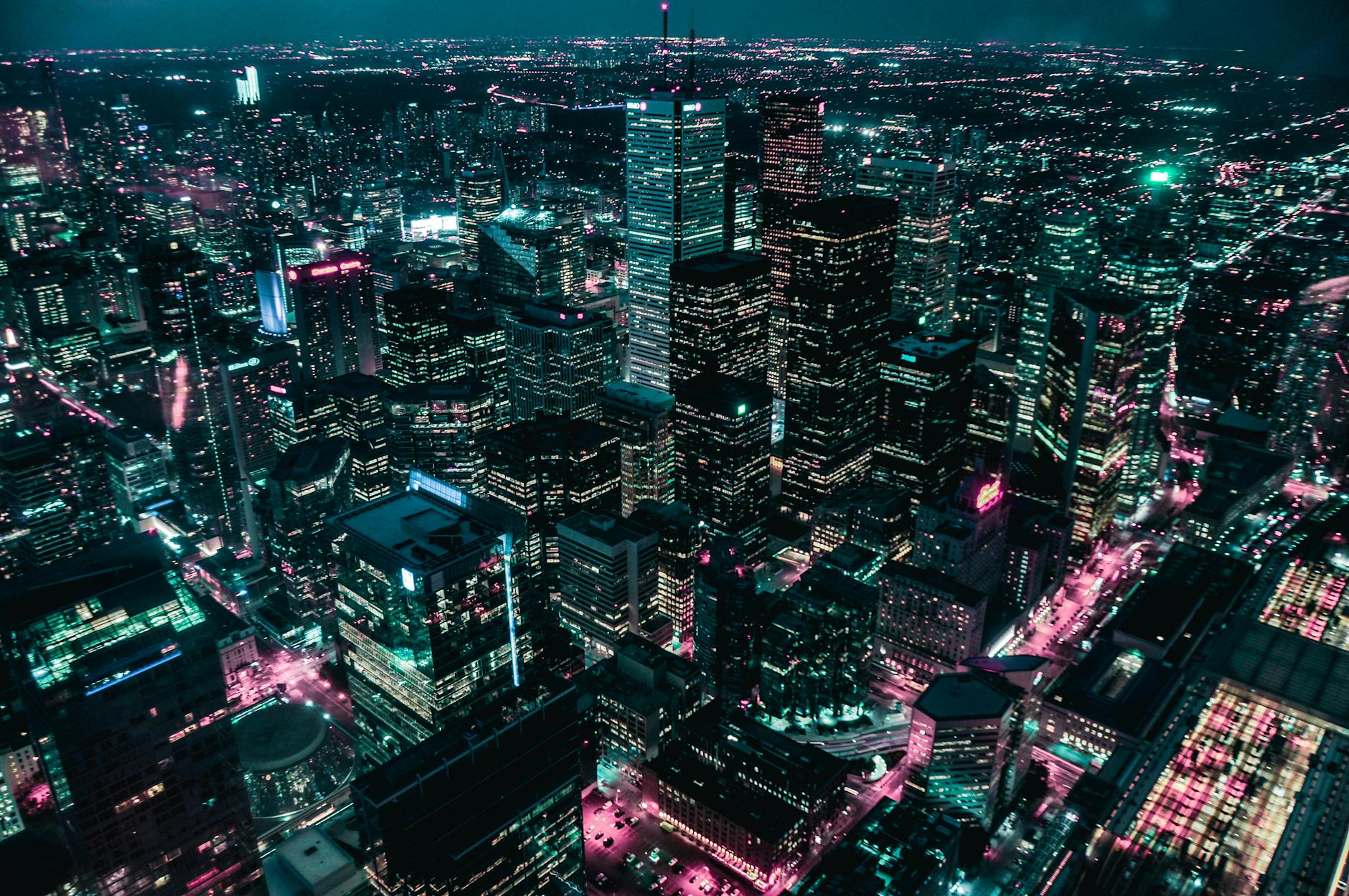
What is Light Pollution?
Definition and Types
Definition and Types
Light pollution means artificial light that is excessive, misdirected, or poorly timed—brightening the night sky and erasing natural darkness.
The main types are:
- Skyglow — the diffuse brightening of the night sky
- Glare — harsh, uncomfortable, or dangerous brightness
- Light trespass — light that spills beyond its intended boundaries
- Over-illumination — more light than is needed
Historical Context and Modern Prevalence
Night lighting has reshaped our cities—and our nights.
- Urbanization and the spread of outdoor lighting have steadily increased nighttime brightness over the past decades. As cities grew and electrification spread, streetlights, signage, and building illumination turned many nights into a brighter, more active environment.
- Today, dense development and around-the-clock activity keep many areas brightly lit after dark. LED and digital lighting are energy-efficient but can cause skyglow if not properly designed or controlled, leaving urban skies brighter than they would be otherwise.
- practical takeaway: Thoughtful design—shielded fixtures, appropriate color temperature, and smart controls (timers, dimming, adaptive schemes)—can reduce skyglow without sacrificing safety or usability.
| Key Point | What it Means | Impact |
|---|---|---|
| Urbanization & outdoor lighting | More streets, buildings, and signs lit at night | Contributes to a large rise in nighttime brightness |
| LED/digital lighting | Energy-efficient, often blue-rich spectra | Can create skyglow if not shielded or properly controlled |
Bottom line: The shift from darker, earlier nights to bright, 24/7 urban life helps explain why nighttime light is a prominent cultural topic today, even as efforts promote smarter lighting to protect dark skies and ecosystems.
Real-World Examples
Real-World Examples of Light Pollution in Action
- Streetlights spill into homes through windows, while illuminated billboards and bright storefront facades fuel urban skyglow.
- Outdoor arenas and parking lots that stay lit all night contribute to local light pollution.
Why Light Pollution Matters
Impact on Astronomy and Stargazing
Look up tonight and you’re looking at a shared canvas for science, culture, and wonder—and it’s fading. Skyglow is the bright haze produced by artificial lights scattering in the atmosphere. It reduces contrast in the night sky, making many stars and faint objects harder to see. Here are the key impacts on astronomy and stargazing:
- Skyglow lowers contrast and hides faint objects, limiting observations for scientists and stargazers alike. It washes out stars and makes distant galaxies, nebulae, and subtle star patterns harder to detect, especially with modest equipment.
- Losing dark skies also erodes opportunities for education, culture, and inspiration tied to the night sky. Bright skies deprive schools, clubs, and communities of authentic sky experiences, myth-making, and motivation to explore space and science.
Mitigation steps to protect astronomy and stargazing:
- Use fully shielded outdoor lighting and lower brightness to reduce skyglow.
- Choose warmer color temperatures and employ smart controls or curfews to minimize unnecessary lighting at night.
- Support and participate in dark-sky preserves, lighting ordinances, and community programs that promote dark-sky awareness.
- When possible, visit darker sites or planetariums for observing sessions to keep your connection with the night sky alive.
Ecological and Health Effects
Night lighting shapes ecosystems and human health far more than most realize. Here’s a concise, evidence-based breakdown.
- Artificial light disrupts nocturnal wildlife behavior, migration, and reproduction.
- Wildlife rely on natural day–night cues for foraging, predator avoidance, and energy budgets; artificial light can shift when and where they feed or rest.
- Nighttime migration of birds, insects, and marine species can be misdirected by bright lights, leading to disorientation, energy loss, or higher mortality.
- In some species, extended or shifted light exposure can alter hormonal rhythms and breeding timing; effects vary by species and habitat.
- Exposure to inappropriate nighttime light can affect human sleep, circadian rhythms, and overall health.
- Bright or blue-rich light in the evening suppresses melatonin, delaying sleep onset and reducing sleep quality.
- Chronic circadian disruption is linked to sleep problems, fatigue, metabolic changes, mood disturbances, and impaired cognitive function.
- Long-term exposure and irregular work hours are associated with higher risks for metabolic and cardiovascular issues; reducing nighttime light can support better sleep and health.
Energy Use and Climate Implications
Every watt counts: smarter lighting saves money and protects the climate.
- Poorly designed lighting wastes energy and raises greenhouse gas emissions.
- Lights left on when unnecessary waste electricity, and poorly aimed fixtures illuminate spaces that don’t need it.
- Electricity often comes from fossil fuels; wasting it increases CO2 and other greenhouse gases in the atmosphere.
- Grids that rely heavily on fossil fuels experience a bigger climate impact from wasted lighting.
- Cutting unnecessary lighting lowers energy costs and reduces environmental impact without compromising safety.
- Use task lighting, motion sensors, dimmers, and timers to illuminate only when needed.
- Switch to efficient LEDs and leverage daylighting and daylight-responsive controls where possible.
- Thoughtful lighting design supports safety while saving money and cutting emissions.
Economic and Cultural Consequences
Dark skies shape tourism, identity, and everyday life.
- Brightened skies erode tourism, weaken local identity, and diminish the cultural value of the night.
- Economic consequences
- Tourism and night-sky experiences: Destinations known for clear skies attract stargazers; as light pollution grows, night tourism can fall, reducing hotel, restaurant, and tour-guide revenues.
- Business costs and energy use: Poorly aimed or excessive lighting wastes energy and drives up maintenance costs; thoughtful lighting reduces expenses while preserving sky visibility.
- Astronomy, research, and education: Dark skies underpin observatories and citizen-science programs; increased light pollution can limit research and curb educational opportunities.
- Cultural consequences
- Local identity and sense of place: Night skies are part of a community’s character and heritage; their loss can erode a unique local identity.
- Cultural value and practices: Nighttime environments sustain storytelling, festivals, navigation, and rituals tied to celestial cycles.
- Education and inspiration: Clear skies foster science learning and creative expression; diminished skies can limit these opportunities.
- Mitigation and opportunities
- Dark-sky initiatives: Shielded, well-aimed lighting and smart ordinances can preserve sky quality while meeting safety needs.
- Economic opportunities: Investing in dark-sky tourism, certified parks, and partnerships with planetariums can create jobs and bolster branding.
- Policy and design: Engaging the community and using cost-benefit planning help balance safety, energy efficiency, and sky quality.
Key Aspects and Approaches to Mitigation
Causes and Sources
Skyglow and light pollution come from how and where we shine light. Understanding where light escapes—and how we choose lighting—highlights the main culprits and what makes them worse.
- Streetlights, illuminated signage, building facades, and interior light that spills outdoors are the primary sources. They brighten the night sky when fixtures direct light upward or beyond their intended boundaries.
- Blue-rich LEDs and over-illumination worsen skyglow, especially when fixtures lack shielding or are set too bright. Blue light scatters more in the atmosphere, so more of it escapes into the night sky.
Measurement, Standards, and Policies
Lighting policy starts with data. This clear, evidence-based guide shows how we measure artificial light, set standards, and craft rules that protect dark skies and human health.
- Sky brightness, luminance, and radiance metrics—such as the Bortle scale and zenith luminance—quantify light pollution.
- These measurements let communities compare places, track changes over time, and inform policies aimed at preserving dark skies and reducing glare.
- Policies like full-cutoff fixtures, shielding, dimming, and curfews reduce light spill and glare.
- Practical steps include directing light downward with full-cutoff designs, shielding fixtures, lowering light levels during late hours, and setting time-based curfews for nonessential lighting.
| Metric | Description | Typical units |
| Bortle scale | A 1–9 visual sky-brightness scale used to rate how dark the sky is | qualitative (1–9) |
| Zenith luminance | Sky brightness measured directly overhead (the zenith), a key reference for dark-sky quality | cd/m² |
| Luminance | Brightness of a surface as seen by the eye | cd/m² |
| Radiance | Light energy emitted or reflected from a surface per unit area per solid angle, in a given direction | W/(m²·sr) |
Mitigation Strategies for Communities
Mitigation Strategies for Communities
Cut light pollution, save energy, and protect wildlife—start with smarter lighting today. Practical, ready-to-apply steps help neighborhoods make a real difference.
- Adopt dark-sky-friendly lighting designs
- Fully shielded fixtures: use full-cutoff shields to prevent glare and light from spilling above the horizon.
- Appropriate color temperature: choose warm white light, typically 2700K to 3000K, to reduce blue-rich light.
- Reduced lumen output: match brightness to safety needs and visibility—avoid excess illumination.
- Implement timing controls, motion sensors, and adaptive lighting
- Timing controls: set schedules or curfews so lights dim or turn off during late-night hours when activity is low.
- Motion sensors: activate lights only when movement is detected, then dim or switch off when the area is idle.
- Adaptive lighting: adjust brightness based on time, occupancy, or conditions to maintain safety with minimal light.
- Engage residents and businesses with education campaigns and incentives for better lighting
- Education campaigns: provide outreach materials, workshops, and practical tips on best practices and the benefits of dark-sky-friendly lighting.
- Incentives: offer rebates or subsidies for installing shielded fixtures, warm color temperatures, and automated controls; recognize participating businesses.
When communities combine thoughtful design, smart controls, and active engagement, neighborhoods enjoy safer nights, lower energy costs, and a healthier night sky.
Leave a Reply